
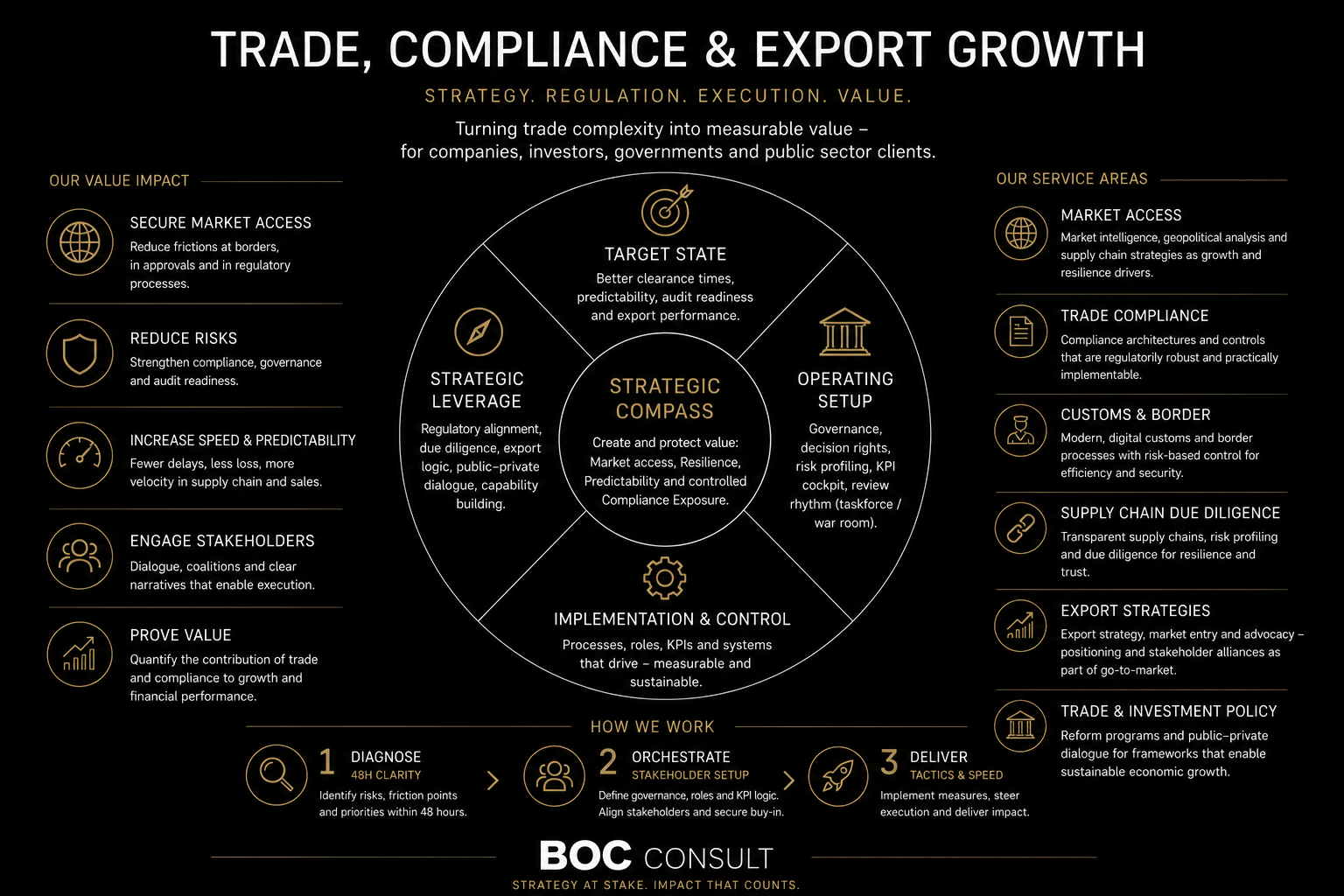
When Regulation, Customs and Supply Chains Determine Value
International trade is no longer a purely operational function. It has become a strategic value driver - and, at the same time, a growing source of risk. In a world shaped by increasing geopolitical tensions, protectionist tendencies, new customs regimes, tighter export controls, sanctions requirements and ever more complex supply chains, the right setup determines whether companies can grow, secure markets, control costs and manage regulatory risk.
What used to be handled in the engine room of logistics, customs, procurement or compliance has moved onto the board agenda. Trade barriers, regulatory friction, border processes, supply-chain evidence, rules of origin, Incoterms, export licences and sanctions screening all have a direct impact on EBIT, cash flow, working capital, delivery capability, reputation and market access. Companies that fail to manage these issues strategically lose time, margin, predictability - and, in the worst case, their licence to grow.
BOC Consult supports companies, investors, governments, development institutions and public-sector clients in translating trade complexity into operational control and measurable business value. Our ambition is not merely to describe regulatory complexity. We make it manageable. We develop robust structures, clear responsibilities, realistic decision-making processes, resilient control systems and KPI-based management models that work in practice - not only on paper. At the heart of our approach is the combination of strategic understanding, international trade and policy experience, operational implementation capability and commercial result orientation. We do not treat Trade, Compliance and Export Growth as separate disciplines. They belong together: market access requires regulatory resilience. Compliance requires operational feasibility. Export growth requires trust, speed, predictability and institutional alignment.
Why Trade Has Become a Leadership Issue
Global value chains are under pressure. Companies need to become faster, more transparent, more compliant and more resilient at the same time. New geopolitical fault lines are reshaping markets. Sanctions, export controls and security-driven policies are redefining room for manoeuvre. Supply-chain regulation is increasing documentation and evidence requirements. Customs and border processes are becoming more digital - but not automatically simpler.
At the same time, expectations from authorities, investors, customers, business partners and the wider public continue to rise.For management, this creates a double challenge. On the one hand, risks must be reduced through stronger due diligence, clear compliance structures, audit readiness, risk profiling and robust control mechanisms. On the other hand, regulation must not become an obstacle to growth. Companies must still be able to enter new markets, optimise supply chains, realise export potential and capture international opportunities.
This is precisely where BOC Consult operates. We help turn regulatory uncertainty into a controllable system. We identify risks, friction points and opportunities across markets, product flows, suppliers, service providers, licensing processes, customs procedures, regulatory requirements and stakeholder expectations. The result is a robust operating model for Trade, Compliance and Export Growth.
Our Strategic Approach
Our approach begins with one clear question: Where does trade determine value today? The answer is rarely found in one single process. More often, value is lost through the interplay of multiple factors: unclear responsibilities, slow approval processes, inconsistent data, limited transparency over goods flows, insufficient risk classification, differing interpretations of regulatory requirements, weak interfaces between Legal, Customs, Procurement, Sales, Finance and Logistics — or a lack of strategic prioritisation by top management.BOC Consult structures this complexity along a clear strategic compass.
First: protect and increase value.
Trade and compliance systems must enable market access, control risks, create cost transparency and improve export capability.Second: define the target state.
The decisive question is what improvement needs to be achieved: faster clearance times, higher audit readiness, fewer delays, lower compliance exposure, better predictability, clearer governance or measurable export success.Third: identify the strategic levers.
These include regulatory alignment, supply-chain due diligence, export logic, public-private dialogue, risk profiling, capability building, stakeholder management and performance steering.Fourth: build the operating setup.
Strategy only becomes effective through governance, decision rights, SOPs, KPI cockpits, review cycles, task-force structures or war-room logic.This creates a system in which management is no longer forced merely to react, but can actively steer.
Services for Companies, Corporations and Investors
For companies, the greatest value often lies in no longer treating trade and compliance as a cost centre or defensive function, but as part of a broader growth and resilience strategy. BOC Consult helps companies translate regulatory requirements into processes, roles and management models that create operational advantage.We analyse existing trade and supply-chain structures, identify critical risks and develop practical solutions across the entire value chain.
These include:
Trade compliance architectures with clear roles, responsibilities, control points and escalation mechanisms.
Risk and opportunity mapping across markets, product groups, goods flows, suppliers, Incoterms, logistics providers and customs processes.
Development of SOPs, approval processes and KPI cockpits for clearance times, exceptions, cost-to-serve, exposure, delivery delays and audit capability.
Design of governance models that effectively connect Legal, Compliance, Customs, Procurement, Sales, Finance, Logistics and Management.
Support for export strategies, market-entry logic, regulatory positioning and stakeholder dialogue.
The objective is always concrete: reduce risk, increase speed, improve predictability, secure market access and demonstrate value contribution.For CFOs in particular, commercial transparency is critical. Customs duties, tariffs, delays, compliance risks, working capital, inventory levels, contractual penalties, delivery failures and cost-to-serve must be translated into a manageable logic. For CEOs, the focus is on growth, resilience, geopolitical agility and strategic prioritisation. For CHROs, the key questions concern skills, roles, change management and organisational implementation. For CMOs and sales leaders, market access, trust, advocacy and stakeholder alliances are central success factors.
Services for Governments, Development Programmes and Public-Sector Clients
BOC Consult also supports governments, international programmes, development institutions and public-sector clients in modernising trade, customs, export and investment systems. Particularly in growth-oriented economies, the quality of customs and border management, export promotion, investment policy and regulatory implementation determines whether companies can become internationally competitive.
Our work focuses on reform and modernisation programmes across the full chain of customs and border management, risk-based control processes, digital customs administration, trade and investment policy, export strategy, export promotion, public-private dialogue, and trade-based analysis and reporting.This is not about abstract reform rhetoric. It is about practical systems that work: clear institutional responsibilities, digital processes, risk-based controls, transparent data, effective governance, measurable KPIs and constructive dialogue between government, business, investors, donors and international partners.
A particular focus lies on value-adding supply-chain reforms. Many countries of origin export raw materials or minimally processed products, while a significant share of value creation takes place later in the global chain. BOC Consult supports programmes that integrate producers, processing SMEs and local value-creation structures more effectively into international markets. The goal is to increase value creation in the country of origin, build export capability and enable local companies to participate in global supply chains more directly, professionally and profitably.
Customs Policy Development & Digitalisation
Modern customs and border systems must meet two requirements at the same time: they must ensure security, control and compliance - while accelerating legitimate trade. A system that only controls creates friction. A system that only accelerates increases risk. The decisive factor is a risk-based, digitally enabled and institutionally robust approach.
BOC Consult supports customs and trade reforms with a focus on risk-based compliance management, risk profiling, private-sector dialogue, digitalisation, change management and performance steering. This includes developing target pictures, analysing existing processes, defining roles and responsibilities, designing control logics, involving private-sector participants and building KPI systems.
Especially in digital reforms, it is crucial that technology is not introduced in isolation. Digitalisation only delivers impact when processes, data quality, institutional responsibilities, control logic and user reality are aligned. BOC Consult therefore connects policy, process and implementation.
Supply Chain Due Diligence and Regulatory Resilience
Supply chains are now subject to intense regulatory and reputational scrutiny. Companies need to know where products come from, what risks are associated with suppliers, markets and goods flows, and how regulatory requirements can be met in a robust and defensible way. Supply-chain due diligence is therefore not only a compliance obligation, but an element of corporate resilience.
BOC Consult supports the development of due-diligence systems that do not merely exist formally, but function operationally. This includes risk analyses, supplier classifications, process design, documentation logic, escalation mechanisms, training, governance structures and management reporting.
The key is that companies do not remain trapped in a purely defensive logic. Strong supply-chain due diligence can stabilise supply chains, build trust with customers and authorities, reduce reputational risks and improve strategic sourcing decisions. When designed properly, it becomes an instrument for better decision-making.
Export Growth: Growth Requires More Than Market Entry
Export growth is not generated by sales alone. It emerges from the interaction of market knowledge, regulatory alignment, resilient supply chains, local acceptance, credible positioning and institutional support. Companies seeking international growth need to understand which rules, stakeholders, risks and expectations actually determine success in target markets.
BOC Consult supports export strategies, go-to-market logic, regulatory market analysis, stakeholder mapping, advocacy, public-private dialogue and institutional positioning. We help companies open up markets not only commercially, but also from a regulatory and reputational perspective.
This is particularly relevant in industries where approvals, standards, certifications, public-sector clients, political frameworks or social acceptance play an important role. In such markets, success is determined not only by the better product, but also by the ability to establish trust, compliance and institutional connectivity.
The Fast Entry Point: Clarity Within 48 Hours
In critical or complex situations, speed matters. BOC Consult therefore offers a fast entry point: within 48 hours, we create an initial, reliable assessment of risks, friction points, stakeholders, decision logics and priorities.
This diagnosis is not a superficial quick check, but a structured starting point for management decisions. We identify where immediate action is required, which risks are commercially relevant, which processes create delays, which stakeholders matter most and which measures can generate short-term impact.
On this basis, we develop the appropriate setup: task force, war room, governance structure, KPI cockpit, SOP programme, stakeholder plan or integrated line implementation. The ambition remains the same: create clarity quickly, prioritise rigorously and execute consistently.
Thinking Trade, Compliance and Growth as One System
Trade and compliance create the greatest impact when they are not considered in isolation. That is why BOC Consult connects this service field with complementary capabilities in brand, market, public affairs, financial communications, crisis and stakeholder management. Market access is not created through correct processes alone, but also through trust, positioning, acceptance and strategic communication.
Especially in complex international markets, an integrated understanding is essential. Which regulatory requirements matter? Which stakeholders need to be involved? Which narratives create trust? Which risks need to be explained to investors, authorities, customers or the public? Which commercial effects can be measured? And what kind of organisation is capable of implementing all of this?
BOC Consult brings these dimensions together in an approach that integrates market access, compliance, acceptance and management capability.
Our Value Contribution
BOC Consult helps organisations rethink and operationalise international trade capability. We reduce regulatory uncertainty, accelerate decision-making processes, improve market access, strengthen audit readiness, increase predictability and make the value contribution of Trade, Compliance and Export Growth visible.
The result is a robust, measurable and management-ready setup for a world in which borders, rules and supply chains once again have a decisive impact on value.